Monthly Archives: September 2026

Facephi deepens its Canadian expansion with Pan-Canadian Trust Framework certification for verified identity

Independent audit places Facephi’s identity digital trust verification service on Canada’s public trust registry

VANCOUVER, BC — September 23, 2026 — Canada is in the middle of rebuilding its defences against fraud. Canadians reported losses of more than $704 million in 2025, the highest figure on record, and identity fraud was the most-reported category.

All of which turns a question that used to be technical into a public one: when an institution opens an account for someone it has never met, how does it actually know who that person is, and who has checked? That is where digital trust stops being an abstract idea and becomes something institutions need to evidence.

Facephi, a digital identity verification and fraud prevention company, announced that its identity verification service has been certified against the Pan-Canadian Trust Framework (PCTF) Verified Person Component at LOA2 by the Digital ID and Authentication Council of Canada (DIACC), following an independent third-party audit. The service now appears on DIACC’s Trusted List, the public registry of identity services that have successfully met the applicable conformance criteria and passed that audit in Canada.

PCTF certification is not a self-declaration. An accredited auditor examines the service against published criteria, reviews the findings independently before granting any certificate, and publishes the result so anyone can look it up. 

For a bank, an insurer or a government department, the practical effect is that a supplier’s assurances become checkable. For the person opening the account, it is one of the few points in the process where an outside party has verified that the protections around their identity work as described.

“Fraud in Canada is not a technology problem waiting for a better algorithm. It is a trust problem, and trust needs evidence,” said José Israel Castro, Identity Solutions Senior Manager North America at Facephi. “Certification is how you produce that evidence. Someone independent examined how we establish that a person is who they say they are, what proof that leaves behind, and whether the proof holds. 

“Trust in the digital age isn’t assumed; it’s proven,” said Joni Brennan, DIACC President. “Facephi’s alignment with our highest identity proofing standards reflects how global technology operators can meaningfully contribute to building a more secure and trusted ecosystem for all Canadians.”

The certification covers the Verified Person Component of the framework at assurance level LOA2 the criteria that govern how a service establishes and confirms that a person is who they claim to be.

Establishing identity at the outset, however, is only part of the problem. Fraud increasingly arrives afterwards: synthetic identities that pass a first check, accounts taken over months later, mule networks recruited from legitimate customers. Facephi brings document and biometric verification, behavioural signals, fraud detection and compliance screening together in a single platform, closing the gaps that disconnected point tools leave behind on the premise that identity is a continuous state, not something an institution confirms once at the door and then files away.

The company, a DIACC member, holds ISO 27001 and SOC 2 Type 2 certifications and opened its Canadian subsidiary in 2026. The certificate and service description are available on the DIACC Trusted List at diacc.ca.

About Facephi

Facephi is a technology company specializing in anti-fraud, digital identity protection, and verification, offering AI/ML-powered solutions for regulated industries. It combines multi-biometrics, behavioural signals, money mule detection, and orchestration into an end-to-end platform that reduces fraud and friction, accelerates go-live in weeks, and ensures regulatory compliance from day one.

With over a decade of experience in technology development, headquartered in Spain and with subsidiaries in North America, APAC, EMEA and LATAM, the company serves clients in more than 30 countries worldwide, providing innovative solutions that address security challenges in an ever-evolving digital environment.

About DIACC
Established in 2012, DIACC is a non-profit strategic alliance of public and private sector members committed to advancing full and beneficial participation in the global digital economy by promoting PCTF adoption and conformity assessment. DIACC prioritizes personal data control, privacy, security, accountability, and inclusive people-centred design. To learn more about DIACC, please visit https://diacc.ca/

Media contact: Irene Hernández Martín · irenehernandez@facephi.com
From Registries to Reality: Connecting Digital Trust Across Land, Energy, and Finance

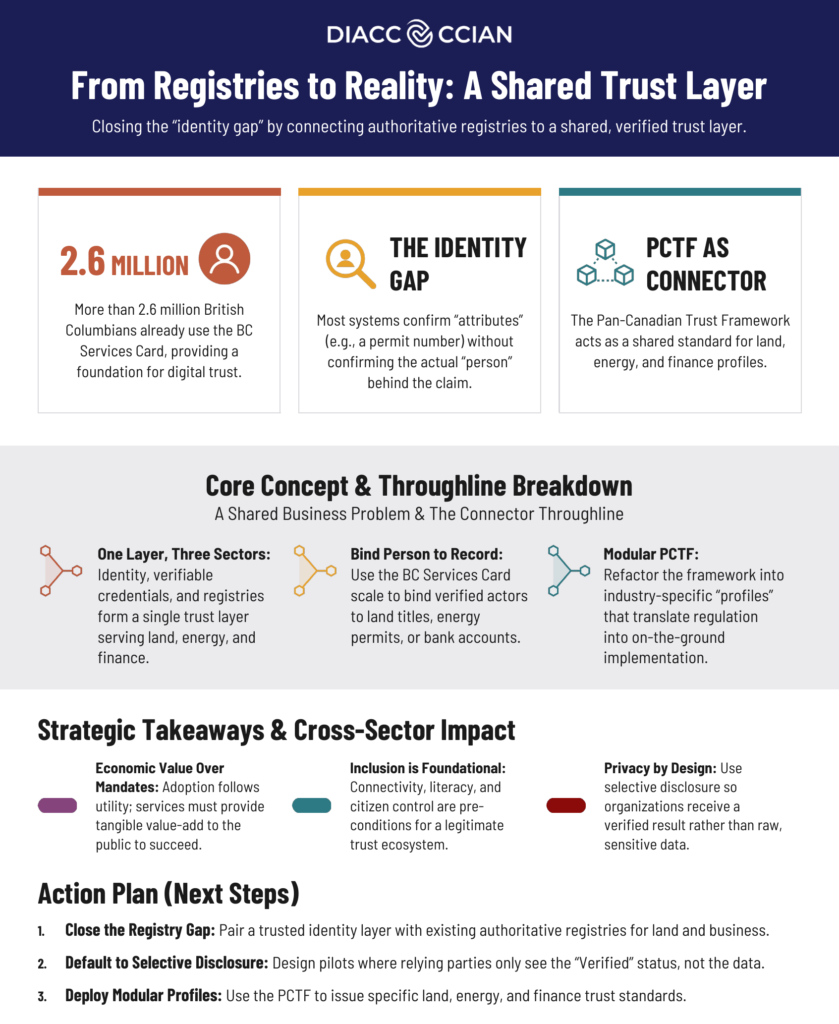
DIACC has released a new workshop report examining how digital trust can connect three critical sectors: land, energy, and finance.

Download the full 35 page report: From Registries to Reality

The report, based on discussions from DIACC’s April 2026 Member Industry Workshop in Vancouver, identifies a common challenge across these sectors: the identity gap – systems can verify information or attributes without necessarily verifying the person or organization behind them.

The report highlights three capabilities that can help close this gap:

  • Verified identity connected to authoritative records
  • Verifiable credentials and selective disclosure to prove what is needed without over-sharing data
  • Interoperable registries that enable trusted information to move across systems

It also explores how the Pan-Canadian Trust Framework (PCTF) can provide a shared foundation for sector-specific applications and help Canada move from digital trust infrastructure to practical, real-world adoption.

The report concludes that Canada already has many of the building blocks for digital trust. The opportunity now is to connect them – and use shared standards to enable trusted transactions across sectors.

Download the full 35 page report: From Registries to Reality

The DIACC Releases its PCTF Automotive Identity Profile Final Recommendation V1.0

Canada’s digital trust leader, the DIACC, releases its Pan-Canadian Trust Framework (PCTF) Automotive Identity Profile Final Recommendation V1.0, establishing a consistent, transparent, and auditable approach to identity verification across the automotive purchasing and financing ecosystem.

Download the PCTF Automotive Identity Profile Final Recommendation V1.0.

Why is the PCTF Automotive Identity Profile important?

The Automotive Identity Profile establishes Conformance Criteria for identity verification in vehicle purchasing and financing. It provides dealerships, lenders, and technology providers with a common set of auditable assurance requirements for digital identity verification services.

By establishing a consistent trust layer across the automotive ecosystem, the Profile helps organizations strengthen fraud prevention, support regulatory and compliance requirements, and build greater confidence in digital vehicle transactions.

What problems does the PCTF Automotive Identity Profile solve?

The automotive sector is increasingly relying on digital processes to verify customers and complete vehicle purchases and financing. At the same time, dealerships and lenders face growing risks from identity fraud, document counterfeiting, and inconsistent identity verification practices.

The Automotive Identity Profile addresses these challenges by providing clear and technology-neutral criteria that can be objectively assessed. This gives automotive organizations greater confidence that identity verification services meet defined assurance requirements and can support secure, privacy-preserving digital transactions.

The Profile also helps reduce variability across the sector by providing a common reference point for dealerships, lenders, and technology providers, supporting more efficient onboarding while maintaining appropriate levels of assurance.

Who does the PCTF Automotive Identity Profile help?

  • Dealerships: Gain greater confidence when selecting and using identity verification services that meet recognized, auditable assurance criteria.
  • Lenders & automotive finance providers: Benefit from greater consistency in identity verification and increased confidence in the controls supporting financing transactions.
  • Identity verification & technology providers: Have clear criteria against which they can demonstrate conformance and build trust with automotive-sector customers.
  • Consumers: Benefit from more secure and consistent identity verification experiences when purchasing or financing a vehicle.

Supporting trust across Canada’s automotive ecosystem

The Automotive Identity Profile demonstrates how the PCTF can be applied to address the specific needs of an industry while providing a common foundation for digital trust.

Developed collaboratively through the DIACC’s Trust Framework Expert Committee and informed by public and private-sector perspectives, the Profile provides the automotive ecosystem with a practical, auditable foundation for strengthening identity verification and reducing fraud.

Spotlight on ESC

1. What is the mission and vision of ESC?

Our vision: to grow ESC through strategic partnerships and strong thought leadership to deliver
an improved, comprehensive and responsive customer experience.

Our mission: to combine technology and expertise to help financial institutions and the legal industry simplify operations, reduce risk, and protect their brand. From due diligence and entity lifecycle management to corporate supplies, our secure platforms streamline workflows and deliver data insights behind reliable compliance decisions. To see the full range of what we do visit eservicecorp.ca.

2. Why is trustworthy digital identity critical for existing and emerging markets?

As organizations continue to digitize their operations and customer interactions, digital trust and identity verification have become a foundation of modern business. In existing markets, they enable organizations to modernize services, strengthen security, and meet evolving regulatory requirements.

Fraud has become more sophisticated at the same time. Synthetic identities and deepfakes, makes it critical for organizations to verify who they are dealing with while maintaining secure and seamless customer experiences and to do so without adding friction to the customer experience. In emerging markets, digital trust and identity verification provide the foundation for new business models and digital services to grow with trust and security.

3. How will digital identity transform the Canadian and global economy? How does your organization address challenges associated with this transformation?

Digital trust and identity verification are enabling organizations to conduct business more securely, efficiently and at greater scale. By reducing fraud, streamlining onboarding, and supporting regulatory compliance, they remove barriers to digital commerce while improving customer experience.

As organizations adopt digital services, they face growing challenges in balancing security, customer experience, and regulatory compliance. ESC brings together trusted data, secure technology and integrated workflows to make verification and compliant onboarding processes more efficient. Direct connectivity to nationwide public registries, credit bureaus and telecommunications data supports both individual (KYC) and entity (KYB) verification while supporting a smoother, lower-friction customer experience.

ESC’s solutions integrate into existing workflows and standardize information across registries and jurisdictions, making results easier to review, understand and act on. By connecting information from multiple trusted sources, we provide greater visibility and actionable insights to help organizations reduce risk, manage compliance, and make informed decisions across the lending lifecycle.

As regulatory expectations evolve, ESC’s solutions are built to adapt, supporting AML and FINTRAC requirements with audit-ready records. From onboarding through ongoing collateral management to recovery, ESC helps organizations reduce risk and operate efficiently in an increasingly connected economy.

4. What role does Canada have to play as a leader in this space?

Canada has an opportunity to be a global leader by fostering collaboration between government, industry and technology providers on interoperable digital identity frameworks. By advancing common verification standards, encouraging innovation and maintaining strong privacy protections, Canada can reduce fraud, simplify digital transactions and strengthen its competitiveness in the global digital economy.

ESC contributes to this ecosystem by supporting organizations with KYC verification and due diligence services and by building trusted digital interactions through our secure technology platforms. Through our participation in DIACC, we look forward to collaborating with industry partners to advance digital trust standards and support the continued evolution of Canada’s digital economy.

5. Why did your organization join the DIACC?

ESC first joined DIACC through our acquisition of Securefact, and we have chosen to rejoin to take an active role in where trusted digital identity in Canada goes next. As organizations increasingly rely on digital interactions, collaboration and common standards are essential to building secure, interoperable and trusted digital ecosystems that benefit businesses and the people they serve. Through our partnership we look forward to sharing knowledge, contributing to industry initiatives and support the adoption of trusted digital identity across Canada.

6. What else should we know about your organization?

ESC has spent decades supporting Canadian organizations manage complex due diligence and compliance requirements at every stage of the asset and entity lifecycle – from searches and registrations to ongoing collateral management and recovery. ESC brings together real time access to trusted registry information, secure technology and industry expertise to help organizations manage risk and meet their compliance obligations in an increasingly complex regulatory landscape.

  • End-to-end due diligence and compliance solutions, all through a single provider from identity and business verification, registry searches and registrations to ongoing management and recovery, helping organizations manage risk throughout the asset and entity lifecycle.
  • Nationwide connectivity to trusted data sources – including nationwide Corporate, PPSA and Land registries, credit bureaus and telecommunications providers, providing reliable information organizations need to make informed decisions.
  • Supporting business through an evolving regulatory landscape – Technology that adapts to meet changing regulatory requirements; supporting organizations meet KYC, AML and FINTRAC obligations.
  • ISO 27001 certified and SOC Type 2 compliant technology infrastructure to help protect sensitive information and support secure, trusted digital interactions.

ESC is a wholly owned subsidiary of Information Services Corporation (ISC), to learn more about our parent company, visit isc.ca.