Monthly Archives: March 2026

Spotlight on DeepIDV

1. What is the mission and vision of DeepIDV?

Mission: To be the definitive AI-native platform for full verification — identity, authenticity, and trust — protecting people, businesses, and systems against deepfakes, fraud, and emerging digital threats in real time.

Vision: To establish deepidv as the global standard for verification across every layer — who someone is, whether what you’re seeing is real, and whether you can trust the interaction. From document and biometric verification to deepfake detection, fraud prevention, and continuous monitoring, deepidv covers the entire trust lifecycle. The long-term play is UAIIP as the universal protocol underpinning verification for both humans and AI agents worldwide.

2. Why is trustworthy digital identity critical for existing and emerging markets?

Digital trust and identity verification are critical because the speed of digital interaction has outpaced the infrastructure built to support it.

In existing markets like financial services, real estate, insurance, and healthcare, organizations are bleeding money on fraud, drowning in compliance costs, and relying on legacy verification tools that only solve one piece of the problem. KYC/AML is still largely manual. Fraud losses run into the tens of billions. The tools they have are fragmented and reactive.

In emerging markets like Web3, AI agent commerce, the gig economy, and age verification, the problem is worse: there’s often no trust infrastructure at all. You can’t scale cross-border fintech without verifying users who don’t have traditional credit histories. You can’t let AI agents transact without a verification layer for non-human actors. You can’t enforce age restrictions with any real teeth.

On top of all of this, the deepfake and synthetic media crisis is accelerating across every sector. Forged documents, synthetic faces beating liveness checks, AI-generated voice and video used for fraud and social engineering. “Seeing is believing” is dead, and no incumbent player is addressing it comprehensively.

The bottom line: digital trust isn’t a feature, it’s infrastructure. The same way commerce can’t function without payments rails, the next decade of digital interaction can’t function without verification rails that cover identity, authenticity, fraud, and continuous monitoring in one layer.

3. How will digital identity transform the Canadian and global economy? How does your organization address challenges associated with this transformation?

Digital trust and identity verification will transform economies by unlocking the full potential of digital commerce, financial inclusion, and cross-border interaction. When trust is embedded into infrastructure, markets move faster, fraud costs drop, regulatory compliance becomes scalable, and entirely new sectors like AI agent commerce and decentralized finance can mature. Globally, the verification market is projected to grow into the tens of billions precisely because every industry is realizing that digital scale without digital trust is a liability.

In Canada specifically, this transformation supports the growth of fintech, proptech, and the digital services economy while addressing rising fraud, identity theft, and regulatory demands around AML and privacy compliance. It also positions Canadian companies to export trust infrastructure globally, particularly into emerging markets that lack legacy systems and are building digital-first.

deepidv addresses the challenges of this transformation by providing a single AI-native platform that covers the full verification lifecycle, not just identity. We handle document and biometric verification, deepfake and synthetic media detection, real-time fraud and behavioral risk scoring, background intelligence, and continuous monitoring. Where incumbents offer fragmented point solutions, deepidv delivers one integrated layer that works across industries and geographies. Our hardware line, deepcam, extends that same trust layer into the physical world for access control and surveillance. And our long-term protocol vision, UAIIP, is designed to establish a universal verification standard for both humans and AI agents, ensuring the infrastructure scales with the economy rather than falling behind it.

4. What role does Canada have to play as a leader in this space?

Canada is uniquely positioned to lead in digital trust and identity verification due to its strong AI research ecosystem, progressive privacy regulation, and established reputation as a trusted jurisdiction for financial services and technology exports. The country’s investment in AI through hubs like the Vector Institute and MILA, combined with frameworks like PIPEDA and emerging provincial digital ID initiatives, creates a foundation that few countries can match. Canada has the opportunity to set global standards for how verification infrastructure is built and exported, particularly into emerging markets that need trusted, privacy-respecting solutions from day one. deepidv is building exactly that from Toronto, with the ambition to make Canadian trust infrastructure a global export.

5. Why did your organization join the DIACC?

We joined the DIACC because digital trust isn’t something any single company builds alone. DIACC is at the center of Canada’s digital identity ecosystem, shaping the frameworks, standards, and policy conversations that will define how verification infrastructure scales nationally and globally. Being part of that community allows deepidv to contribute our perspective as a full verification platform while staying aligned with the direction the broader ecosystem is moving. It also positions us alongside the institutions, governments, and technology partners who share the goal of making Canada a global leader in digital trust.

6. What else should we know about your organization?

deepidv isn’t just another identity verification company. We’re building the infrastructure layer for trust in a world where you can no longer believe what you see, hear, or read online. Our platform covers the full spectrum of verification, from identity and document checks to deepfake detection, fraud prevention, behavioral risk scoring, and continuous monitoring, all in one AI-native system.

We’re a small, focused team operating across Toronto, San Francisco, and Dallas, moving at a pace that incumbents in this space simply can’t match. We’ve closed a $1M seed round, built hardware and software product lines simultaneously, and are actively deploying across verticals like proptech, fintech, and emerging markets. Our long-term vision is UAIIP, a universal protocol for verifying both humans and AI agents, because the next wave of digital interaction won’t just be person to person. It will be agent to agent, and nobody has built the trust layer for that yet.

What sets us apart is that we see verification as a lifecycle, not a checkpoint. The industry has been stuck on one-time identity checks while fraud, deepfakes, and synthetic media have evolved far beyond what those tools can catch. deepidv exists to close that gap entirely.


Spotlight on ProofofID

1. What is the mission and vision of ProofofID?

ProofOfID’s mission is to empower individuals and organizations with secure, user-controlled digital identity solutions that enable trusted, frictionless interactions across physical and digital environments.
We envision a world where identity is no longer a liability but an asset, where individuals own, control, and consent to how their data is shared, and organizations can instantly verify trust without compromising privacy. ProofOfID aims to become a foundational layer in the global digital trust ecosystem, enabling interoperable, privacy-preserving identity verification at scale.

2. Why is trustworthy digital identity critical for existing and emerging markets?

Digital trust is the backbone of today’s economy. As services move online, from banking and healthcare to government and commerce, verifying identity securely and accurately becomes crucial. In existing markets, the challenge is to reduce fraud, streamline compliance, and improve the user experience. Identity fraud, synthetic identities, and data breaches continue to cost billions annually.
In emerging markets, the opportunity is even more transformative. Trusted digital identity unlocks financial inclusion, access to government services, and participation in the digital economy for millions who are currently underserved.
Without a trusted identity:
– Transactions cannot be secured
– Services cannot scale safely
– Inclusion remains limited

3. How will digital identity transform the Canadian and global economy? How does your organization address challenges associated with this transformation?

Digital trust will fundamentally reshape how economies operate by:
– Reducing fraud and compliance costs ands accelerating onboarding and service delivery.
– Enabling cross-border digital commerce and empowering individuals with control over their data.
However, this transformation introduces key challenges such as privacy concerns and data misuse, fragmented identity systems, lack of interoperability, and growing sophistication of fraud.

ProofOfID addresses these challenges by:
– Enabling user-consented identity sharing (trust to authorize), putting individuals in control.
– Providing real-time validation and fraud detection signals.
– Designing for interoperability with existing ecosystems and standards.
– Minimizing data exposure through secure, decentralized, and tokenized identity verification
Our approach shifts identity from being stored and vulnerable to being dynamically verified and controlled.

4. What role does Canada have to play as a leader in this space?

Canada is uniquely positioned to lead globally in digital trust due to its strong regulatory frameworks, innovation ecosystem, and commitment to privacy. Through organizations like DIACC, Canada has already established itself as a pioneer in:
– Pan-Canadian trust frameworks
– Public-private collaboration
– Standards-based interoperability
Canada’s role should lead by showcasing trusted solutions like ProofOfID, setting global benchmarks for privacy-respecting digital identity, fostering innovation, maintaining trust and security, and enabling cross-border interoperability with like-minded nations.

5. Why did your organization join the DIACC?

ProofOfID joined DIACC to collaborate with industry leaders and contribute to the development of a trusted, interoperable digital identity ecosystem in Canada.
We believe that solving identity challenges requires collective effort, not isolated innovation. DIACC provides a platform to:
– Align with national standards and frameworks
– Contribute our expertise in user-controlled identity and fraud prevention
– Partner with organizations shaping the future of digital trust
Our participation reflects our commitment to building solutions that are not only innovative but also aligned with Canada’s broader digital trust vision.

6. What else should we know about your organization?

ProofOfID is a patent-backed digital identity platform designed to redefine how identity is shared and verified.
Key differentiators include:
– User-centric identity control; individuals approve and monitor how their identity is used
– Fraud prevention by design; real-time alerts and verification signals help detect suspicious activity
– Scalable and interoperable architecture; built to integrate across industries and jurisdictions
– Enterprise and government-read; supporting high-volume, high-assurance identity use cases
– It’s not just another one-time KYC/IDV solution; it enables the reuse of verified PII data.
As we enter the market, our focus is on enabling secure digital ecosystems across financial services, telecommunications, government, and beyond while ensuring trust remains at the core of every interaction.

Spotlight on RegHub

1. What is the mission and vision of RegHub?

To simplify identity verification and modernize access to registry services by providing a trusted, consolidated solution for Know Your Business (KYB), Know Your Customer (KYC), and PPSA search and registration services.

2. Why is trustworthy digital identity critical for existing and emerging markets?

Trustworthy digital identity is critical to both established and emerging markets because it enables organizations to confidently verify individuals and businesses, prevent fraud, and comply with regulatory requirements while delivering seamless digital experiences. Organizations must balance strong verification and compliance obligations with the need to deliver fast, low-friction digital experiences.

RegHub addresses these challenges by providing a consolidated workflow across the full lending lifecycle—identity verification, onboarding, and funding. By offering KYC, KYB, and PPSA registration and search in a single platform, RegHub enables organizations to see more connected data across the lending process—from identity verification through to security lien activity sourced from trusted government registries.

3. How will digital identity transform the Canadian and global economy? How does your organization address challenges associated with this transformation?

Digital identity will transform the Canadian and global economy by enabling secure, trusted digital interactions as financial services, government programs, and commerce move online. RegHub addresses these challenges by providing a consolidated workflow across the full lending lifecycle—identity verification, onboarding, and funding.

By offering KYC, KYB, and PPSA registration and search in a single platform, RegHub enables organizations to see more connected data across the lending process—from identity verification through to security lien activity sourced from trusted government registries.

For Know Your Business (KYB), RegHub provides an automated attestor workflow aligned with the requirements of Financial Transactions and Reports Analysis Centre of Canada (FINTRAC) to capture Ultimate Beneficial Ownership (UBO) information, combined with PEP and sanctions screening and government-sourced corporate registry results. An interactive ownership diagram visually maps multiple layers of ownership, helping compliance teams clearly identify and validate the true UBO.

By connecting identity verification with registry and lien activity, RegHub gains broader visibility across the onboarding and funding process. This allows the platform to actively monitor data signals and generate insights that help organizations combat fraud and manage risk more effectively. Through Next-Generation Registry technology delivered via APIs and the RegHub Portal, organizations can automate compliance workflows, improve operational efficiency, and significantly reduce onboarding and funding costs.

Together, this integrated approach helps organizations build trusted digital relationships, strengthen compliance, and support the continued evolution of digital identity in Canada and global markets.

4. What role does Canada have to play as a leader in this space?

Canada is well positioned to lead in digital identity by advancing trusted, privacy-focused frameworks that support secure digital transactions while maintaining strong data protection. With established regulatory oversight and trusted government registries, Canada can set global standards for transparency, fraud prevention, and responsible identity verification.

RegHub supports this leadership by connecting KYC, KYB, and PPSA registration and search within a single workflow, leveraging trusted government data to verify identities, confirm Ultimate Beneficial Ownership (UBO) through an attestor process aligned with Financial Transactions and Reports Analysis Centre of Canada requirements, and provide visibility into security lien activity. Through API-driven and portal-based registry technology, RegHub helps organizations improve compliance, reduce fraud, and operate more efficiently in a trusted digital identity ecosystem

5. Why did your organization join the DIACC?

RegHub joined the Digital ID and Authentication Council of Canada (DIACC) to support the development of a trusted and interoperable digital identity ecosystem in Canada. As digital identity becomes critical to financial services, lending, and digital commerce, collaboration between industry and government is essential to establish strong standards and reduce fraud.

RegHub contributes practical expertise through our integrated KYC, KYB, and registry solutions, helping advance secure, compliant identity verification while improving efficiency and trust in digital transactions

6. What else should we know about your organization?

Key Points About RegHub

1. End-to-End Digital Verification: RegHub offers a consolidated workflow across KYC, KYB, and PPSA registration/search, giving organizations a full view of individuals and businesses throughout the lending and compliance lifecycle.

2. Regulatory Alignment: Our KYB workflow is automated and attestor-based, fully aligned with Financial Transactions and Reports Analysis Centre of Canada (FINTRAC) requirements, including UBO collection, PEP/sanctions screening, and government-sourced corporate registry validation.

3. Fraud Prevention & Risk Insights: By combining identity verification with registry and security lien data, RegHub actively monitors and generates insights to combat fraud and reduce operational risk.

4. Interactive Ownership Transparency: Our ownership diagrams map complex corporate structures, helping organizations identify and validate the true Ultimate Beneficial Owner (UBO).

5. Next-Gen Technology: Delivered via APIs and the RegHub Portal, our platform supports automation, operational efficiency, and cost reduction while providing seamless access to trusted government data.

6. Trusted Partner in Canada’s Digital Identity Ecosystem: RegHub is committed to supporting DIACC’s mission to create a secure, interoperable digital identity ecosystem, helping Canada set global standards for privacy, trust, and innovation

Case Study In Success – Credivera

Credivera Scales Verifiable Credentials Platform to 30+ Countries, Earns Government of Canada Trust

Download this Case Study as a PDF

Fast Facts

  • Organization: Credivera (TerraHub Technologies Inc.)
  • Sector: Technology / Workforce Digital Identity
  • DIACC Member Since: 2021
  • Headquarters: Calgary, AB (with presence in Ontario and Quebec)
  • Solution Type: PCTF-Aligned Verifiable Credentials Platform

Key Results

  • 30+ countries: Global deployment across highly regulated industries
  • Weeks → seconds: Credential verification time transformation
  • Government validated: Approved vendor for the Government of Canada
  • Fraud prevention: Tamper-proof, real-time credential verification, eliminating fraudulent entry
  • PCTF Alignment: W3C standards-based verifiable credentials, Government of Canada UCVDC Challenge winner

Gatekeeping made easy: verify safety tickets in seconds and keep sites compliant.

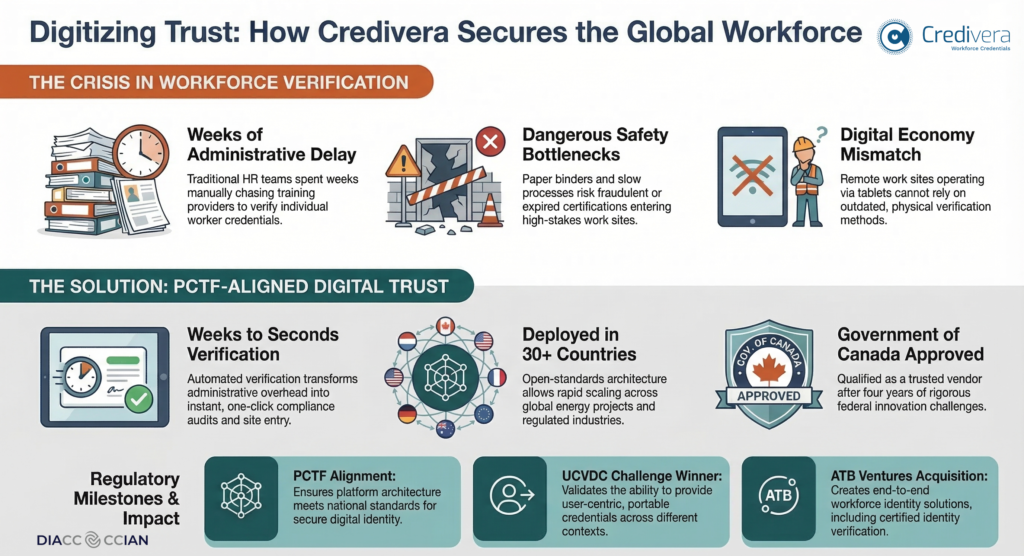
When construction and energy companies face thousands of workers needing instant verification of safety and trades certifications across remote sites, paper binders and weeks-long processes become dangerous bottlenecks.

Credivera transformed this challenge into a competitive advantage by deploying a PCTF-aligned, verifiable credentials platform now trusted in 30+ countries—including winning approval as a Government of Canada vendor after four years of rigorous innovation challenges and testing.

The Challenge

When Manual Verification Became a Safety Risk

Canada’s construction and energy sectors faced a growing crisis: as projects scaled and work sites went digital, traditional credential verification couldn’t keep pace.

Site managers juggled binders of paper certifications. Managers were often unsure if a tradesperson’s safety ticket, licence or training was current, authentic, or even legitimate. HR teams spent weeks chasing down training providers to verify credentials before workers could start. The stakes were high: fraudulent certifications risked lives, while slow verification delayed projects and locked out qualified workers.

CANA Group of Companies, one of Canada’s oldest construction organizations, hit this wall as new projects ramped up. “The construction industry is at a crossroads for change,” said Luke Simpson, CANA’s President. “Traditional processes do not always work in this new digital economy, which consists of online training and remote work sites now operating from phones or tablets.”

For highly regulated industries, the problem extended beyond construction. Associations managing professional credentials, government agencies handling workforce verification, and global firms coordinating across borders all faced the same fundamental challenge: proving someone’s qualifications in a digital, privacy-respecting, tamper-proof way—instantly.

“The ability to digitally verify credentials along with other documentation is an essential tool for the OHS profession to enable the public and employers to make informed decisions when hiring or contracting for services.”

— Paul Belair CRSP, Chair, BCRSP Governing Body

The Solution

Building Canada’s Workforce Trust Infrastructure

Credivera’s founders recognized a problem with trust infrastructure. The solution required open standards that could work globally while meeting Canada’s evolving digital identity requirements. By deploying verifiable credentials, Credivera sought to enable individuals to quickly and securely prove their identity and qualifications, without compromising privacy or operational efficiency.

DIACC membership provided the critical framework. Learning about the Pan-Canadian Trust Framework through government pilot work, Credivera aligned its platform architecture with PCTF principles from the ground up. “As a participant in emerging advancements in digital identity for the government, Credivera learned of the Pan-Canadian Trust framework and aligned with DIACC’s initiatives,” the company shared in its DIACC member spotlight.

The Credivera Exchange deploys W3C-standard verifiable credentials—cryptographically signed digital documents that workers hold in secure digital wallets. When a training provider issues a certification, it’s timestamped, tamper-proof, and instantly verifiable by employers without endless phone calls or email chains. Workers control their own credentials, sharing them with a tap while maintaining privacy.

“The reason why verifiable credentials work for us and our customers is that […] should there be a revocation of that credential, it will be immediately known.”

– Dan Demers, Director of Business Development, CannAmm

Between 2019 and 2023, Credivera won and completed multiple Innovation, Science and Economic Development Canada (ISED) Innovation Challenges, including the User Centric Verifiable Digital Credentials (UCVDC) Challenge. Working with Treasury Board Secretariat and Shared Services Canada, they demonstrated standards-based portable credentials could work across contexts—reducing human error, increasing efficiency, and ensuring veracity through cryptography.

The rigorous testing paid off: Credivera became an approved vendor authorized to sell its platform to the Government of Canada departments, crown corporations, and agencies.

The Results

Measurable Impact

  • Weeks to seconds: “We went from weeks of administration to a simple click of a button” for preparing safety certifications and COR audits—transforming administrative overhead into instant verification
  • 30+ countries deployed: Credivera’s open-standards approach enabled rapid global expansion across highly regulated industries, from Canadian construction sites to international energy projects
  • Government of Canada approved: After four years of innovation challenges and testing, Credivera qualified as a trusted government vendor—validation of both technical capabilities and PCTF alignment
  • Fraud elimination: Tamper-proof credentials with real-time verification from source providers prevent fraudulent certifications from entering work sites, protecting worker safety and reducing corporate liability
  • Real-time compliance: Companies in the trades sector now pre-approve workers for site entry instantly, increasing “time on tools” and eliminating compliance delays that previously cost days or weeks per project

“As a participant in emerging advancements in workforce identity, we aligned with DIACC’s initiatives and are excited to share knowledge and assist in creating the future of workforce identity together.”

— Dan Giurescu, CEO, Credivera

The Future Outlook

Scaling Canada’s Digital Trust Ecosystem

Credivera’s government approval opens new frontiers. Their 2025 acquisition of ATB Ventures’ Oliu™ identity verification platform, the first Canadian platform to achieve PCTF certification through DIACC, creates end-to-end workforce identity solutions for Alberta and beyond.

Credivera is positioned to help shape how verifiable credentials scale across sectors. Their work with associations (BCRSP for safety professionals, Intelelos for medical credentials, MyCreds for post-secondary education), training providers (We Know Training for skilled trades), occupational testing services (CannAmm), employers and partnerships with verification services (Mintz Global Screening, AuraData) demonstrates how PCTF-aligned infrastructure enables ecosystem growth.

As provinces explore digital ID initiatives and federal standards evolve, Credivera’s combination of in-production deployments and government validation makes it a key player in Canada’s digital trust infrastructure.

Call-To-Action

For Organizations Managing Workforce Credentials:
If your industry struggles with onboarding, compliance, interoperability, slow manual verification, growing fraud risks, and stricter privacy rules, PCTF-aligned solutions offer a reliable solution.

Interested in learning how Credivera can transform your workforce credential management? Connect with their team to discuss your specific needs: credivera.com or info@credivera.com.

DIACC membership connects you to the standards, ecosystem partners, and government alignment that enabled Credivera’s success. Learn more about how membership and the Pan-Canadian Trust Framework can transform your credential management: diacc.ca/membership